Enclosed & Cargo Trailer Awnings built to bolt on right.
Add a custom awning to the enclosed cargo trailer you already own — engineered, custom-fabricated frame awnings, not bolt-on RV kits. Heavy aluminum A-frames, billet brackets, and proper wall backing so it stays put weekend after weekend. Built in Little Falls, MN and shipped nationwide since 1983.
If it’s got a wall, it’s a candidate.
Cargo, race hauler, stacker, vending rig — the awning mounts to the sidewall structure, so the box style matters less than what’s behind the skin.
- Enclosed cargo & V-nose trailers. The most common retrofit — flat side, plenty of run to hang a wide span.
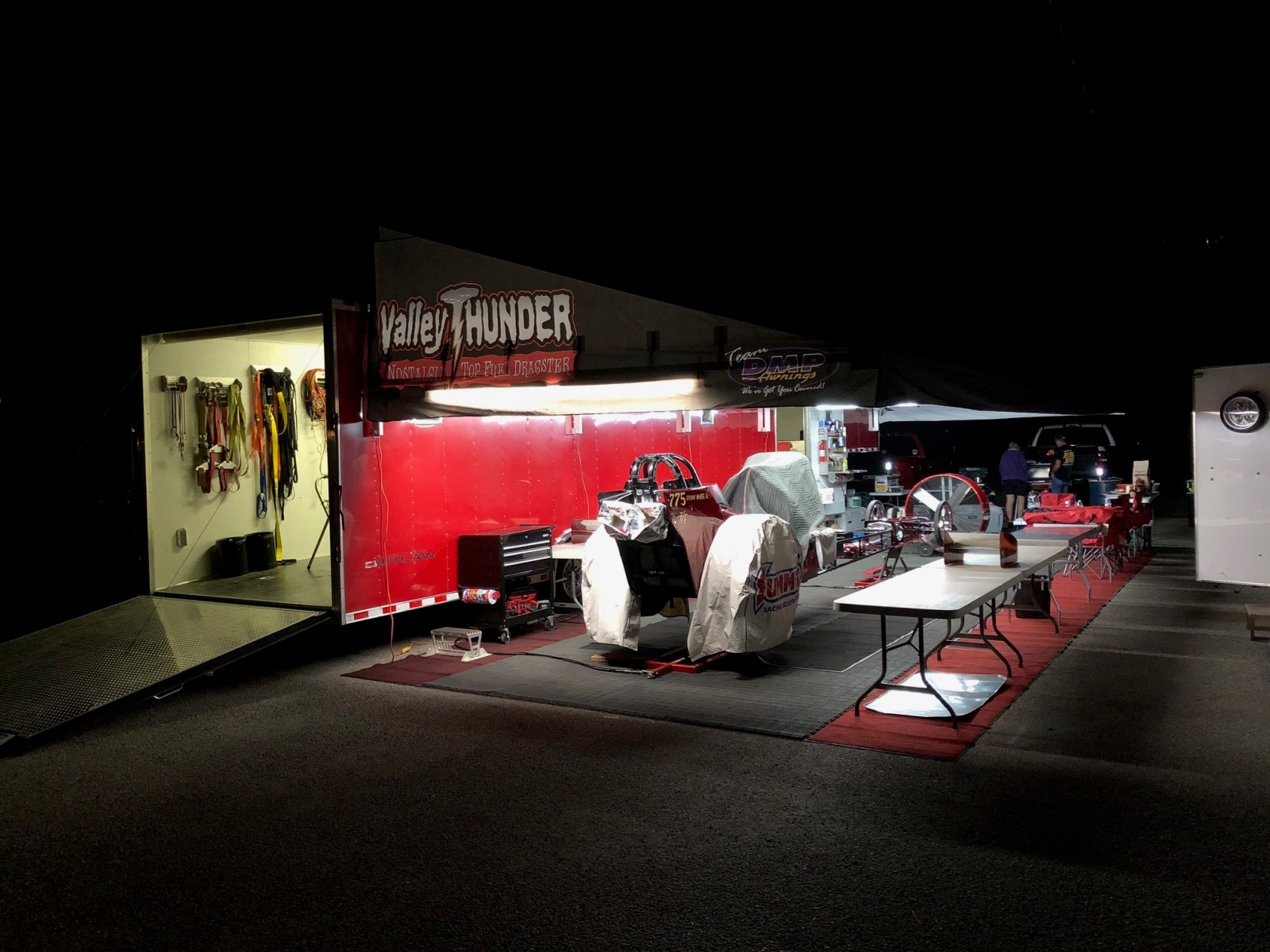
- Enclosed race haulers. Purpose-built for the pits with quick connect/disconnect. See race trailer awnings.
- Stacker & toy-hauler trailers. Taller walls, more mounting height. See stacker trailer awnings.
- Concession & vending trailers. Awning doubles as your storefront cover. See display & vendor awnings.
It won’t tear loose.
The horror stories — awnings pulling straight out of a hollow aluminum wall — come from hardware bolted through thin skin with nothing behind it. A wide awning is a long lever, and wind loads that lever hard. We engineer the mount around the load instead of hoping the skin holds.
- Clear-anodized billet brackets. Machined solid, they spread load across the wall instead of concentrating it on a few fasteners.
- Proper backing, every time. Aluminum-skin trailers get backing plates or backers behind the skin so bolts pull against structure, not just a sheet.
- Steel-stud & framed walls. We tie the mount into the wall framing where it can carry the load.
- Stainless hardware. Fasteners that won’t rust and back out on the interstate.
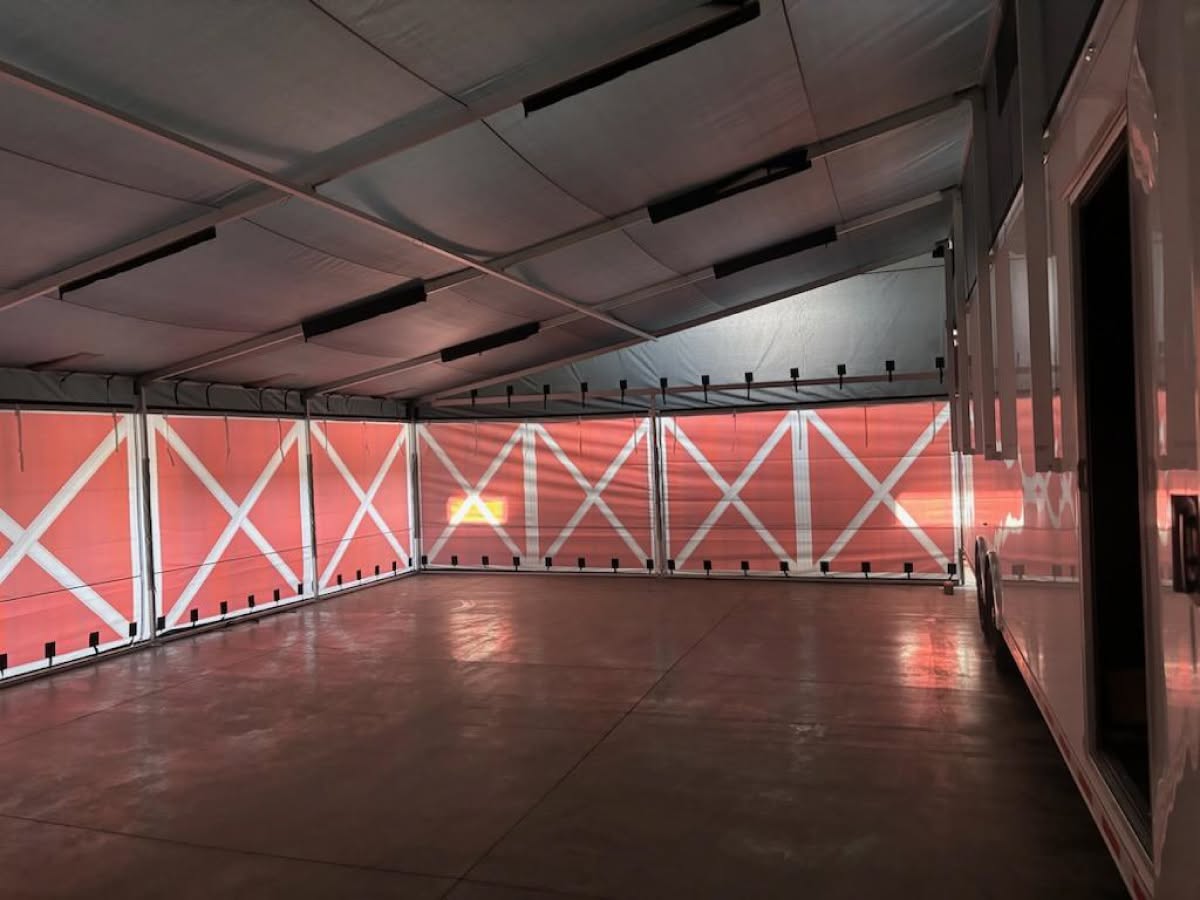
How it attaches.
Two common wall builds, one goal: bolts that pull against real structure. If you’re not sure what’s behind your skin, tell us the trailer make and model and we’ll walk it with you.
Match the awning to your box.
Jump to your trailer’s length. Every DMP awning is custom, so these are starting points — we spec the exact run to your wall and how much shade you want. The free-hanging span runs 12–14 ft with no legs in the way; wider and leg-supported builds are available.
- 16 ft trailers. A compact single-car or utility hauler. A run covering the main door and work zone is plenty — a straightforward race trailer awning fits most 16-footers.
- 20 ft trailers. Room for a full free-hanging span and then some. Popular for racers who want the whole staging area shaded — pair with side walls to close it in.
- 24 ft trailers. The sweet spot. A long side gives you a generous covered pit or display area; a race or hospitality awning both work well here.
- 28 ft trailers. Enough wall to run a wide awning plus a separate entrance cover. Good for teams that want work space and a hosting space.
- 32 ft trailers. Big-rig territory. Long spans and multi-section builds shade a serious footprint — hospitality and vending setups shine at this length.
- 40 ft trailers. Gooseneck and semi-style haulers. We build in sections to cover the run and can integrate display & vendor features for midway setups.
- 53 ft trailers. Full semi trailers for pro teams and traveling shows. Sectioned awnings turn the whole side into covered hospitality or vending frontage.
Fixed frame, not roll-up.
DMP builds custom fixed-frame awnings for enclosed and cargo trailers. We do not sell, install, service, re-cover, or repair RV roll-up, retractable, or spring-arm awnings — brands like Solera, Dometic, Carefree, or Lippert. Those spring-arm RV units are typically rated to only around 20–25 mph before you have to roll them up; our fixed-frame builds are a different animal entirely.
| Feature | DMP Awnings | RV roll-up kit |
|---|---|---|
| Frame | Heavy aluminum A-frame | Spring arms |
| Wall mounting | Billet brackets + backing | Skin-mount rail |
| Legs in your work area | None (12–14 ft free-hang) | Ground poles |
| Built for a trailer | Yes, custom | Generic RV part |
Enclosed trailer awning questions.
Can you add a complete awning to an enclosed trailer?+
Yes — retrofitting a custom awning onto an enclosed cargo or race trailer is exactly what we do. We build the frame to your trailer’s wall height, length, and door layout, then supply the billet brackets and backing to mount it right. New rig or one you’ve run for years, start a free quote with your trailer make and model.
How do you mount an awning to aluminum vs. steel walls?+
On aluminum-skin trailers we use backing plates or backers behind the skin so the bolts pull against structure instead of a thin sheet — that’s what stops the “ripping out” problem. On steel-stud or framed walls we tie the mount into the framing. Either way, clear-anodized billet brackets spread the load and stainless hardware keeps it tight. Our measure & install guide walks the details.
What size awning fits a 24 ft trailer?+
A 24-footer is the sweet spot — the long side gives you room for a generous covered pit or display area. The free-hanging span runs 12–14 ft with no legs; wider and leg-supported builds are available if you want to cover more. Because every awning is custom, we spec the exact run to your wall and how much shade you’re after. Tell us your plans on the quote form.
Do you repair or re-cover RV roll-up awnings?+
No. DMP builds custom fixed-frame awnings only — we don’t sell, install, service, re-cover, or repair RV roll-up, retractable, or spring-arm awnings like Solera, Dometic, Carefree, or Lippert. If you want a heavy-duty fixed-frame awning built for your enclosed trailer, that’s our lane.
Keep looking.
Got an enclosed trailer? Let’s put an awning on it.
Send us your trailer make, model, and length — we’ll spec a fixed-frame awning that bolts on right and stays put. No prices online; every build is quote-only.
Start Your Quote →