It's the debate that comes up in every pit and every trailer-forum thread: bolt a roll-up RV awning — a Solera, Dometic, or Carefree — onto the side of the rig, or invest in a custom fabricated frame awning built for a trailer. Both put fabric over your head. They are not the same tool, and picking the wrong one costs you a whole season. This guide lays out the honest trade-offs so you can decide before you spend a dime.
Straight talk first
So there's no confusion: DMP builds custom fixed-frame awnings only. We do not sell, install, service, re-cover, or repair roll-up, retractable, or spring-arm RV awnings — not Solera, not Dometic, not Carefree, not Lippert. If a roll-up is genuinely the right answer for you, an RV dealer or service center is who you want, and we'll say so. This is buyer-decision content, not a sales pitch dressed up as advice. Where a roll-up wins, we'll tell you.
The debate racers actually have
A roll-up RV awning is designed for the sidewall of a motorhome or travel trailer: retract it with an arm and a spring, drive away, deploy it at the campsite. It's light, it's cheap, and for parking-lot shade it's fine. A custom frame awning is a different animal — a welded aluminum structure fitted to your trailer, meant to be thrown up and torn down every weekend and to carry your sponsors down the highway. The question isn't which is "better" in the abstract. It's which one matches how hard you're going to use it.
Projection & coverage
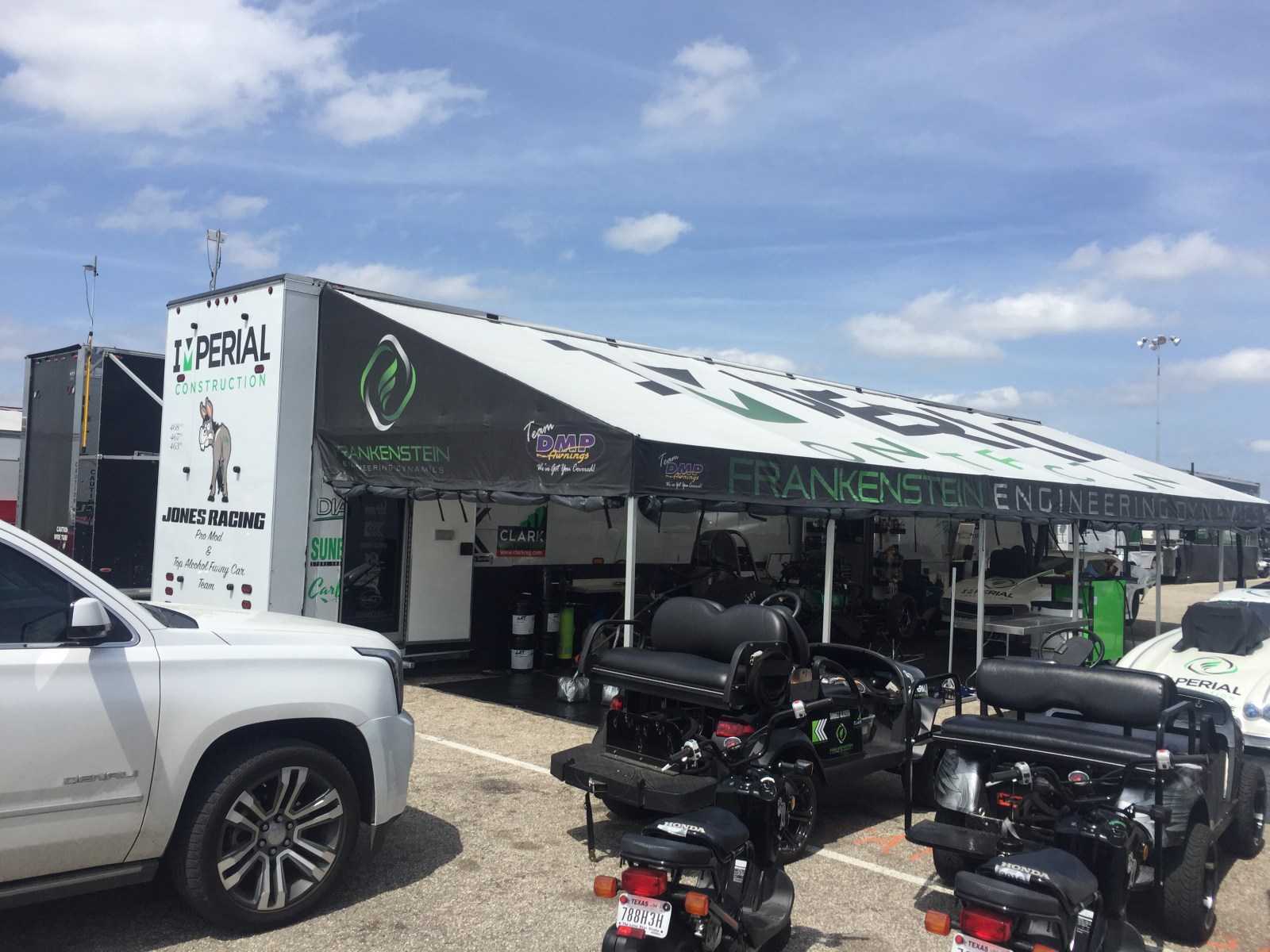
Coverage is where the gap shows up fast. Most roll-up RV awnings reach out only a few feet off the wall — enough to shade a couple of camp chairs. A DMP fixed-frame awning free-hangs a 12 to 14 foot span with no legs, and wider or leg-supported builds are available for bigger rigs. That extra reach is the difference between shading a doorway and shading a whole work area where you can roll a car under, run air and power, and move crew without ducking. If people work under your awning, projection isn't a nice-to-have.
Wind & weather
This is the one that catches people out. Spring-arm RV awnings are commonly rated for only light wind — often around 20 to 25 mph — and every manufacturer tells you to roll them up when the weather turns. That's not a knock; it's what a spring-and-arm design is. A welded aluminum frame is a fundamentally different structure. We build our A-frames from oversized 1.5″ × 2″ × .125″ wall aluminum with billet brackets and stainless hardware, so the frame holds its shape under load. We don't publish a specific wind rating — conditions and setup vary too much to promise a number — but the build is not comparable to a retractable arm.
Cargo-door clearance
Roll-up units mount to a flat RV sidewall at a fixed height. On an enclosed cargo or race trailer with a tall ramp door or side man-door, that mounting point fights you: the awning either sits too low to clear the door swing or ends up in an awkward spot to make room. A custom frame is measured and CNC-machined to your trailer, so it clears your doors, follows your roofline, and mounts where it actually works. Fit isn't cosmetic here — it decides whether you can even open the trailer with the awning up.
Springs, arms & failure points
Every mechanism is a thing that can break. Roll-up awnings live and die by their spring tension and arm assemblies, and under hard, repeated use — the kind a racing season delivers — those are the parts that fail: a spring lets go, an arm bends, the fabric tensioner quits at the worst moment. A fixed frame has no springs and no retracting arms to wear out. It sets up with a quick connect / disconnect system and stows in a one-piece zipper and fabric storage bag. Fewer moving parts, fewer roadside surprises.
Printed graphics & branding
For a race or vendor rig, the awning is the biggest flat billboard you own. Roll-up RV awnings come in stock fabrics and a handful of colors — branding means sticking on decals that peel and curl. DMP runs dye-sublimation large-format printing in-house, so sponsor logos, team colors, and full-color art are printed into the fabric and matched to your wrap and banners. If sponsors are part of why you're buying, a roll-up simply doesn't compete on this front.
Longevity & cost of ownership
A cheaper roll-up looks like the frugal choice until you count the season. Light-duty arms and springs, stock fabric, and decal graphics don't age well under weekly setups and highway miles — replace one mid-year and the "cheap" option isn't. A welded aluminum frame, built once to your trailer, is meant to outlast the trailer it's bolted to. Spend once on a build that holds up, or spend again every time a mechanism gives out. For hard users, the math favors the frame.
When a roll-up from an RV shop is all you need
Here's the honest part. If you're a weekend camper, an occasional user, or you just want shade over a doorway a few times a year — and budget is the deciding factor — a roll-up RV awning from an RV dealer is the sensible call. Light, occasional, low-stakes use is exactly what a Solera or Dometic is designed for. You don't need a fabricated frame to shade a lawn chair at the lake, and we won't pretend you do. Buy the roll-up, enjoy it, and skip the custom build. A frame awning earns its keep when the use is hard, frequent, and branded — not when it's light and occasional.
Can you put a Solera or Dometic on an enclosed cargo trailer?
Physically, yes — people bolt roll-up RV awnings onto enclosed cargo trailers all the time. Whether it's the right move is another question. Roll-ups are engineered for RV sidewalls: they project short, mount at a fixed height that rarely lines up with a cargo or ramp door, and rely on spring-arm hardware that a racing schedule chews through. For an enclosed cargo trailer awning that has to clear a tall door, span a real work area, and carry graphics, a custom fabricated frame is built for the job the roll-up is only borrowed for. If you're weighing frames specifically, our race trailer awning buying guide walks through what to look for.
Buy the roll-up for the campsite. Buy the frame for the pits. Just don't ask a spring-arm awning to do a fabricated frame's job.
Side-by-side comparison
| Feature | Roll-up RV awning | DMP custom frame awning |
|---|---|---|
| Projection / coverage | Short reach off the wall | 12–14 ft free-hanging |
| Legs in your work area | Often, or short reach | None — free-hanging |
| Wind behavior | Light-duty (roll up early) | Welded aluminum frame |
| Cargo / ramp-door clearance | Fixed height, may not clear | Machined to your trailer |
| Moving parts to fail | Springs & arms | No springs or arms |
| Sponsor graphics | Stick-on decals | Printed into the fabric |
| Best for | Light, occasional camp use | Hard, weekly, branded use |
| Sold / serviced by DMP | No — see an RV dealer | Built & shipped nationwide |
Still deciding? Compare the full lineup on the awnings page, dig into race trailer awning details, or start a free quote and we'll spec a frame for your exact trailer.