Horse Trailer Awnings & Canopies built to stay put.
A custom fixed-frame awning for the horse trailer you already own: a heavy aluminum A-frame, a cover sewn in-house, and billet brackets backed into the wall, shipped as a complete kit. Built in Little Falls, MN and shipped nationwide since 1983.
A horse trailer awning kit, the DMP way.
No shelf of part numbers and no surprise add-ons. This is what ships with every DMP awning, built to your trailer’s measurements.
Heavy Aluminum A-Frame
Oversized 1.5″ × 2″ × .125″ wall aluminum, welded in-house.
StandardOne-Piece Fabric Cover
Sewn in-house in your choice of colors and fabrics, with printing available right in the fabric.
StandardClear-Anodized Billet Brackets
Machined brackets and plates that spread the load across your wall and don’t corrode.
StandardStainless Hardware
Every mounting fastener is stainless steel, so nothing rusts or seizes after a wet weekend.
StandardQuick Connect / Disconnect
Tool-light setup and teardown. One or two people deploy it in minutes.
StandardOne-Piece Zipper
Sewn in, not a paid add-on, so the cover seats evenly on the frame every time.
StandardFabric Storage Bag
The cover packs into its own bag and rides in the trailer between trips.
StandardCustom-Machined Fit
Brackets and frame CNC-machined to your trailer’s measured wall height and length.
StandardFree-Hanging 12 to 14 ft
No legs or poles under the awning. Wider and leg-supported builds are available.
StandardEvery spec in one place: the awning catalog & kit specs.
Backed into the wall, not hung on the skin.
A wide awning is a long lever, and wind loads that lever hard. The stories of awnings pulling out of a trailer wall come from hardware bolted through thin skin with nothing behind it. We engineer the mount around the load instead.
- Aluminum skin. Backing plates or backers go behind the skin so the bolts pull against structure, not a thin sheet.
- Framed walls. On steel-stud or framed walls, the mount ties into the framing where it can carry the load.
- Billet brackets. Machined solid and clear-anodized, they spread the load across the wall instead of a few fasteners.
- Height-matched. Brackets are machined to your wall height at the mount line, so the awning hangs where you can stand and work under it.
Not sure what’s behind your trailer’s skin? Send the make and model and we’ll work through it with you. More on wall types on our enclosed trailer awnings page.
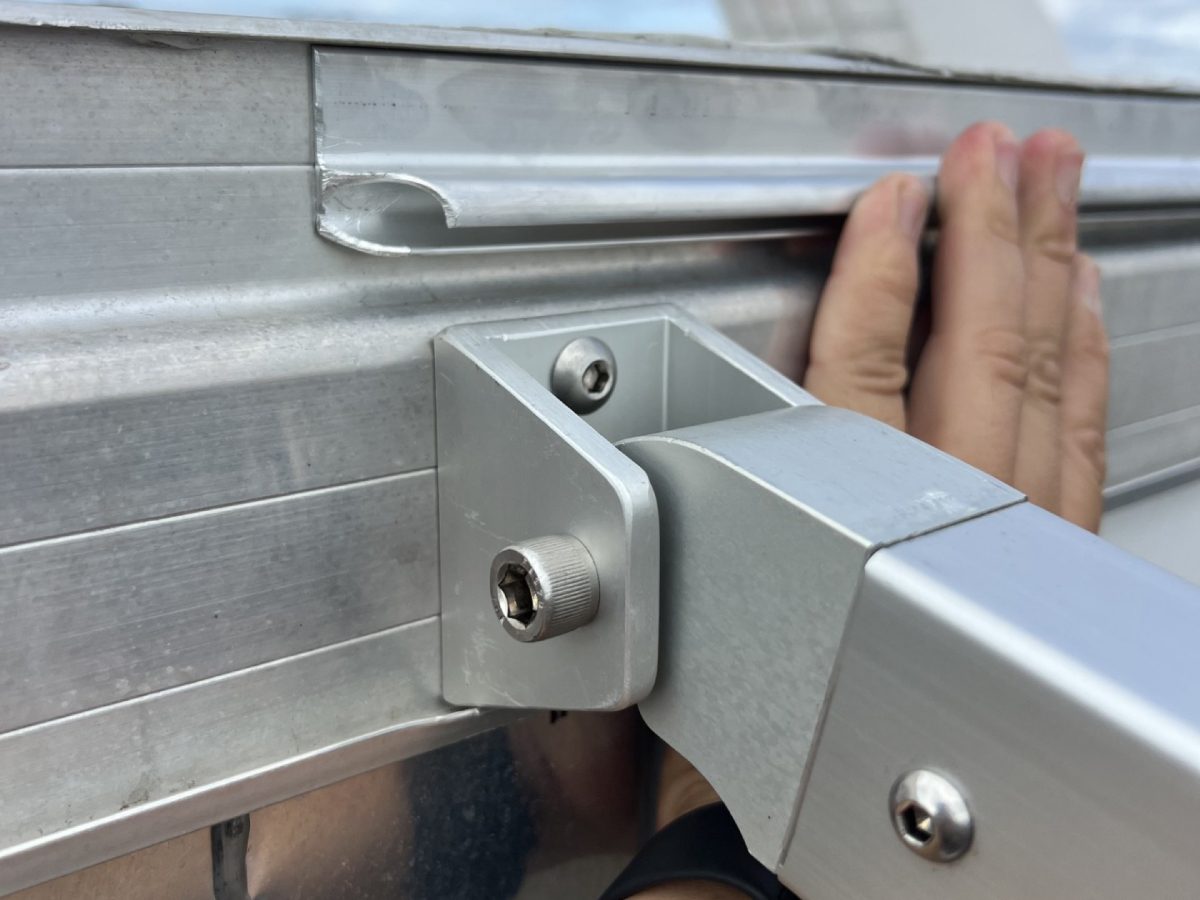
Four numbers start the spec.
We confirm every dimension with you before anything is cut. These are the ones we ask for first.
Mounting Length
The usable run along the side you want covered. It sets the awning length.
Wall Height
Ground to the mount line. It drives the bracket machining and where the awning hangs.
Doors & Obstructions
Every door, vent, light, and piece of trim on that side, and which way the doors swing, so the frame clears them.
Ground-to-Floor Height
How the trailer sits. Goosenecks and drop axles change where the shade needs to land.
Send those numbers and a couple of photos of the trailer side with your quote. The measure & install guide walks each one, and tall & low trailer fits shows how wall height changes the build.
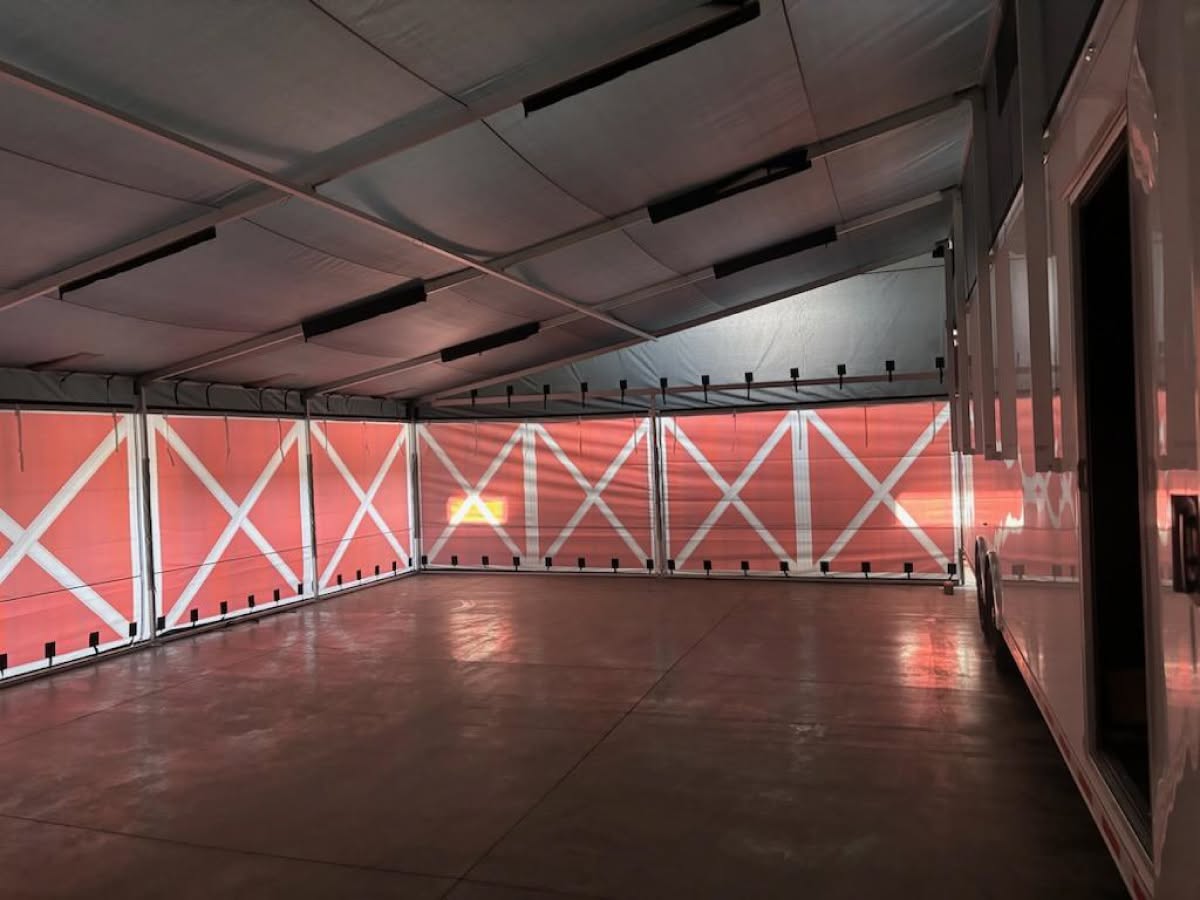
Shade when you want it, walls when you need them.
An open awning is shade. Add walls and it becomes a room. DMP sidewalls zip on or slide into keder track, then roll into the same storage bag when you don’t need them.
- Solid panels. Block sun, rain, and wind, and keep your setup private.
- Mesh panels. Let the air through and keep the sun and bugs off.
- Clear panels. Let daylight in without opening up to the weather.
- Printed panels. Carry your name or logo, printed right into the fabric.
Mix them however you like. Every panel type is on sidewalls & enclosures.
Leave it up, or take it down?
A heavy fixed frame gives you more margin than a roll-up, but no awning should ride out a storm. We don’t publish a magic mph number, because the real limit depends on your tie-downs, the ground you’re staked into, and how the wind hits you. Here’s the short version of our wind & weather guide.
| Situation | The call | Why |
|---|---|---|
| Light, steady breeze | Leave it up | Normal weather for a heavy fixed frame that’s tied down right. |
| Gusty and building | Watch it closely | Check the tie-downs, drop the sidewalls, and be ready to strike it. |
| Storm front rolling in | Take it down | The leading edge of a storm brings sudden gusts. Strike it before the front arrives. |
| Leaving the trailer unattended | Take it down | Weather can turn while you’re away, and nobody is there to react. |
| Overnight | Take it down, or stay ready | If it stays up, it needs to be dialed in and someone accountable for it. |
| Long, steady rain | Pitch it to shed water | Standing water adds weight in one spot. Knock off any belly of water before it grows. |
Horse trailer awning questions.
Is a horse trailer canopy the same thing as a horse trailer awning?+
To us, yes. Both words describe the same part: a custom fixed-frame cover that bolts to the side of your trailer and deploys off it in minutes. The one thing it is not is a free-standing pop-up canopy tent.
Is a DMP awning a kit I can install myself?+
Every DMP awning ships as a complete kit: the aluminum A-frame, a one-piece cover with its zipper, clear-anodized billet brackets, stainless mounting hardware, quick connect/disconnect hardware, and a fabric storage bag. It mounts with the included hardware, and because it’s built to your trailer’s measurements, you’re mounting to a known layout, not improvising. Our measure & install guide covers the tools and the steps.
Will it fit a bumper pull or a gooseneck horse trailer?+
The awning mounts to the trailer’s sidewall, so the hitch style matters less than the wall. We ask for the usable length along that side, the wall height at the mount line, and the ground-to-floor height, because a gooseneck changes where the shade needs to land. Every dimension gets confirmed with you before anything is built.
How do you mount an awning on an aluminum horse trailer?+
On aluminum-skin trailers we put backing plates or backers behind the skin so the bolts pull against structure instead of a thin sheet. On steel-stud or framed walls we tie the mount into the framing. Either way, clear-anodized billet brackets spread the load and stainless hardware keeps it tight.
How far does it reach, and does it need legs?+
A standard DMP awning free-hangs 12 to 14 ft with no legs or poles underneath. If you want to cover more ground, we build wider and leg-supported setups. Just ask on your quote.
Can you fix the roll-up awning that came on my trailer?+
No. DMP doesn’t sell, install, service, re-cover, or repair RV roll-up, retractable, or spring-arm awnings like Solera, Dometic, Carefree, or Lippert. An RV dealer or service center is the right call for those.
What does a horse trailer awning cost?+
There’s no price list, because every awning is quoted to the trailer it mounts on. Size and span, the mounting work, printed graphics or solid fabric, sidewalls, options, and freight all move the number. The quote is free, with no obligation. Our cost factors guide breaks each one down.
Keep looking.
Enclosed & Cargo Awnings
How our awnings retrofit onto enclosed trailers.
// SidewallsSidewalls & Enclosures
Solid, printed, clear, and mesh panels.
// CatalogAwning Catalog & Kit Specs
What comes in every kit, spec by spec.
// GuideMeasure & Install
The dimensions we need and how it mounts.
// WeatherWind & Weather Guide
When to leave it up and when to strike it.
// PrintPrinted & Branded Awnings
Your name and logo printed into the cover.
Take the shade with you.
Send us your horse trailer’s make, model, and length, plus a photo of the side you want covered. We’ll spec a fixed-frame awning built to that wall. Every build is quote-only, and the quote is free.
Start Your Quote →